
Jin-Woo Park1, Kyoung-Mo Koo1, Ji-Hyun Park1,2,3,*, Lamiya Abasova4, In-Young Choi5,6,*, and Hyeon-Dong Shin3,7
1Department of Forest Resources, Kookmin University, Seoul 02707, Korea
2Forest Carbon Graduate School, Kookmin University, Seoul 02707, Korea
3Department of Forestry, Environment, and Systems, Kookmin University, Seoul 02707, Korea
4Western Caspian University, Baku AZ1001, Azerbaijan
5Department of Plant Medicine, Jeonbuk National University, Jeonju 54896, Korea
6Research Center for Plant Medicine, Jeonbuk National University, Jeonju 54896, Korea
7Division of Environmental Science and Ecological Engineering, Korea University, Seoul 02841, Korea
*Corresponding authors: jhpark10@kookmin.ac.kr, iychoi@jbnu.ac.kr
Korean Journal of Mycology (Kor J Mycol) 2026 September, Volume 54, Issue 3, pages 287-294.
https://doi.org/10.4489/kjm.2026.54.3.6
Received on June 25, 2026, Revised on September 02, 2026, Accepted on September 08, 2026, Published on September 30, 2026.
© 2026 THE KOREAN SOCIETY OF MYCOLOGY.
This is an Open Access article distributed under the terms of the Creative Commons Attribution Non-Commercial License (http://creativecommons.org/licenses/by-nc/4.0/) which permits unrestricted non-commercial use, distribution, and reproduction in any medium, provided the original work is properly cited.
Conidial germination, Evergreen spindletree, Molecular phylogeny, Oidium euonymi-japonici, Pseudoidium euonymi-japonici
Powdery mildew fungi that occur on Euonymus species are currently classified into five species [1]. Among them, the two major species, Erysiphe euonymi and E. euonymicola, are closely related but distinct, differing mainly in host association and morphological characteristics [2,3]. Erysiphe euonymi occurs mainly on deciduous Euonymus species, whereas E. euonymicola is associated with evergreen Euonymus species, especially Eu. japonicus Thunb. and Eu. fortunei var. radicans Rehder [1,2]. The latter Erysiphe species usually occurs as an anamorph, and chasmothecia are rarely observed, which has contributed to its complicated taxonomic history.
The powdery mildew of Eu. japonicus, in particular, has been treated under multiple taxonomic concepts [4]. It was originally described as Oidium euonymi-japonici and has subsequently been treated under several synonyms, including Microsphaera euonymi-japonici and E. euonymi-japonici [4]. However, Braun and Cook [2] noted that the common anamorph on Eu. japonicus had never been conclusively linked to the teleomorph described as M. euonymi-japonici. They, therefore, introduced E. euonymicola as a distinct species based on anamorphic and teleomorphic material collected from Eu. japonicus [2].
In Korea, powdery mildews on Eu. japonicus have been recorded under the names O. euonymi-japonici and E. euonymi-japonici [5–7], but both names are now regarded as taxonomic synonyms of E. euonymicola [2]. In addition, powdery mildews associated with Eu. fortunei var. radicans have been recorded as E. euonymicola based on morphological characteristics and internal transcribed spacer (ITS) sequence data [8]. However, these previous identifications were all based on the characteristics of the anamorph, and while E. euonymicola is distributed on evergreen Euonymus species worldwide, several aspects of its anamorphic morphology remain poorly documented. Specifically, information on primary conidia, conidial germination patterns, and the affected plant organs is limited. Therefore, the present study aimed to re-examine the identities of the powdery mildews on Eu. japonicus and Eu. fortunei var. radicans based on the current taxonomic framework and to provide additional information on the anamorph characteristics of E. euonymicola.
A total of 41 powdery mildew specimens, 35 from Eu. japonicus and 6 from Eu. fortunei var. radicans, were examined for morphological investigation. All of the specimens were collected throughout Korea between 1989 and 2025 and are preserved in the Korea University Herbarium (KUS). Among the 41 specimens, which were each examined morphologically, seven well-preserved specimens were selected for molecular analyses, with preference given to specimens collected from different localities. These specimens are listed in Table 1.
Table 1. Powdery mildew specimens from Euonymus species used for molecular analyses in this study
| Specimen number | Host | Infected organ | Locality | Collection date | GenBank accession number ITS | LSU |
|---|---|---|---|---|---|---|
| KUS-F31502 | Euonymus japonicus | Leaves | Jeju | 19-Nov-2019 | PZ542729 | PZ542737 |
| KUS-F31636 | Euonymus japonicus | Leaves | Seoul | 02-May-2020 | PZ542731 | PZ542740 |
| KUS-F32768 | Euonymus japonicus | Leaves | Jeonju | 28-Apr-2022 | PZ542732 | PZ542742 |
| KUS-F33267 | Euonymus japonicus | Fruits | Jeonju | 24-Sep-2022 | PZ542734 | PZ542744 |
| KUS-F27836 | Euonymus fortunei var. radicans | Leaves | Seoul | 07-Jun-2014 | PZ545116 | PZ542768 |
| KUS-F28747 | Euonymus fortunei var. radicans | Leaves | Seoul | 28-Jul-2015 | PZ545117 | PZ542748 |
| KUS-F29160 | Euonymus fortunei var. radicans | Leaves | Seoul | 20-May-2016 | PZ542738 | PZ542745 |
ITS: internal transcribed spacer; LSU: large subunit; KUS-F: Fungal specimens of Korea University Herbarium.
Powdery mildew symptoms were commonly observed on the leaves and young stems of Eu. japonicus and Eu. fortunei var. radicans (Fig. 1A). Colonies developed on infected leaves, with chlorotic spots often forming on the adaxial surface when colonies were abundant on the abaxial surface (Fig. 1B). When infections were severe, dense mycelial growth covered the entire leaf, resulting in distorted and malformed leaves (Fig. 1C and D). Notably, powdery mildew was also observed on the fruits of Eu. japonicus, and the fruits were frequently covered with mycelia (Fig. 1E and F).
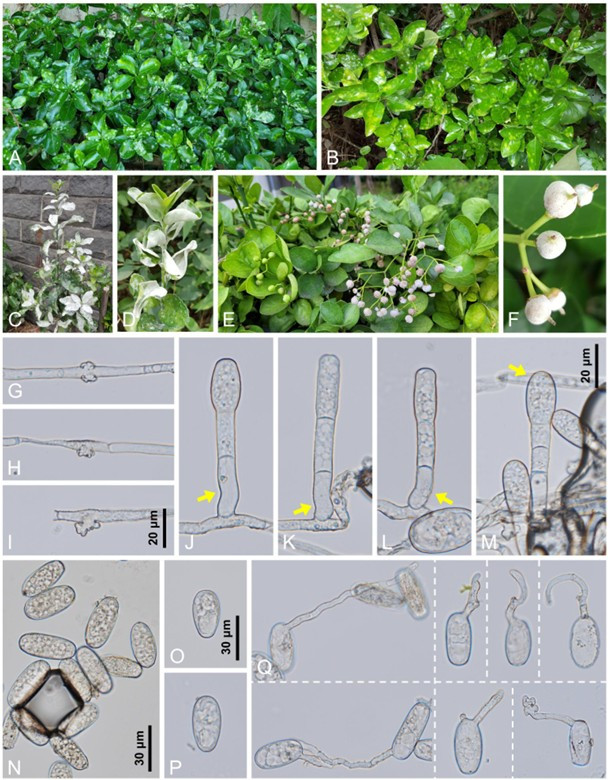
Fig. 1. Erysiphe euonymicola, a powdery mildew fungus found on Euonymus japonicus. A: Powdery mildew symptoms on leaves. B: Chlorotic spots formed on the adaxial surface. C: Dense mycelial growth covering entire leaves. D: Leaf distortion and malformation caused by severe infection. E: Powdery mildew infections on fruits. F: Close-up view of infected fruits. G–I: Appressoria on the hypha. J–L: Conidiophores. Note the mostly flexuous foot-cells (arrows). M: Conidiophore bearing a primary conidium (arrow). N: Diversity of conidia. O, P: Primary conidia. Q: Conidia in germination.
For morphological characterization, mycelia and conidia were removed from the infected tissue using a sterile scalpel, mounted in distilled water, and examined using an Olympus BX53-32XDIC light microscope equipped with an Olympus DP74 digital camera (Olympus, Tokyo, Japan). For each morphological feature, measurements were based on at least 30 structures. Conidial germination patterns were examined following the method of Sivapalan [9], with conidia suspended in distilled water.
Hyphae were straight to flexuous, measuring 4–5 µm wide. Hyphal appressoria were lobed to multilobed, occurring singly or in opposite pairs, and measured 7–12 µm wide (Fig. 1G–I). Conidiophores were erect, cylindrical, and 62–83 µm long, arising from the upper surface of the mother cell. Foot-cells were cylindrical and mostly flexuous, measuring 17–27 × 8–9 µm, and they were followed by 1–2 shorter cells (Fig. 1J–M). The basal septum was consistently located at the branching point (Fig. 1J–L). Conidia were produced singly and lacked distinct fibrosin bodies (Fig. 1N). Primary conidia were ellipsoidal, measuring 32–35 × 15–18 µm, with rounded apices and subtruncate bases (Fig. 1O and P). Secondary conidia were cylindric-ellipsoidal to oblong-elliptical, measuring 34–44 × 13–18 µm. The germ tube arose from a subterminal position on the conidium and terminated in a lobed appressorium, hook-shaped apex, or simple and rounded end. Occasionally, two germ tubes arose from a single conidium (Fig. 1Q). Although specimens were collected over multiple years and across a broad seasonal range (May–December), chasmothecia were not observed in any of the materials examined. The observed morphological characteristics corresponded well with previous descriptions of Erysiphe euonymicola U. Braun [2].
To confirm the morphology-based identification and clarify the phylogenetic relationships of powdery mildew fungi infecting Euonymus species in Korea, genomic DNA was extracted from seven representative specimens: three collected from Eu. japonicus leaves (KUS-F31502, F31636, and F32768), one from Eu. japonicus fruits (KUS-F33267), and three from Eu. fortunei var. radicans leaves (KUS-F27836, F28747, and F29160). The nucleotide sequences of the ITS regions and the large subunit (LSU) gene of the rDNA were amplified using the primer pairs ITS1-F/PM6 [10] and PM3/TW14 [11], respectively. Sequencing was performed by Cosmogenetech (Seoul, Korea), and the resulting sequences were deposited in GenBank under the accession numbers listed in Table 1. Sequence alignment and editing were conducted using the MUSCLE algorithm implemented in MEGA11 [12]. Phylogenetic relationships were inferred using the maximum parsimony method in PAUP* 4.0a, with heuristic searches performed through the tree-bisection-reconnection algorithm [13]. All sites were treated as unordered and unweighted, and gaps were treated as missing data. A bootstrap analysis with 1,000 resamples was conducted to evaluate branch support. Arthrocladiella mougeotii HMJAU-PM91837 and Golovinomyces latisporus KUS-F30175 were selected as outgroup taxa [14]. BLASTn searches showed high sequence similarity to both E. euonymicola and E. alphitoides. Separate phylogenetic analyses of the ITS and LSU datasets showed no conflict in the placement of the Korean specimens, which grouped with reference sequences of E. euonymicola in both analyses. The final dataset consisted of 38 combined ITS+LSU sequences with 1,356 characters. In the resulting maximum parsimony tree, all Korean specimens formed a single clade with the reference E. euonymicola sequences from Japan and Taiwan, and the clade was clearly separated from E. alphitoides and the other Erysiphe species (Fig. 2). The E. euonymicola clade received 93% bootstrap support, whereas the subclade containing all Korean specimens was supported by a bootstrap value of 86%. These phylogenetic results support the placement of all powdery mildew occurring on Eu. japonicus and Eu. fortunei var. radicans in Korea into a single species, E. euonymicola.
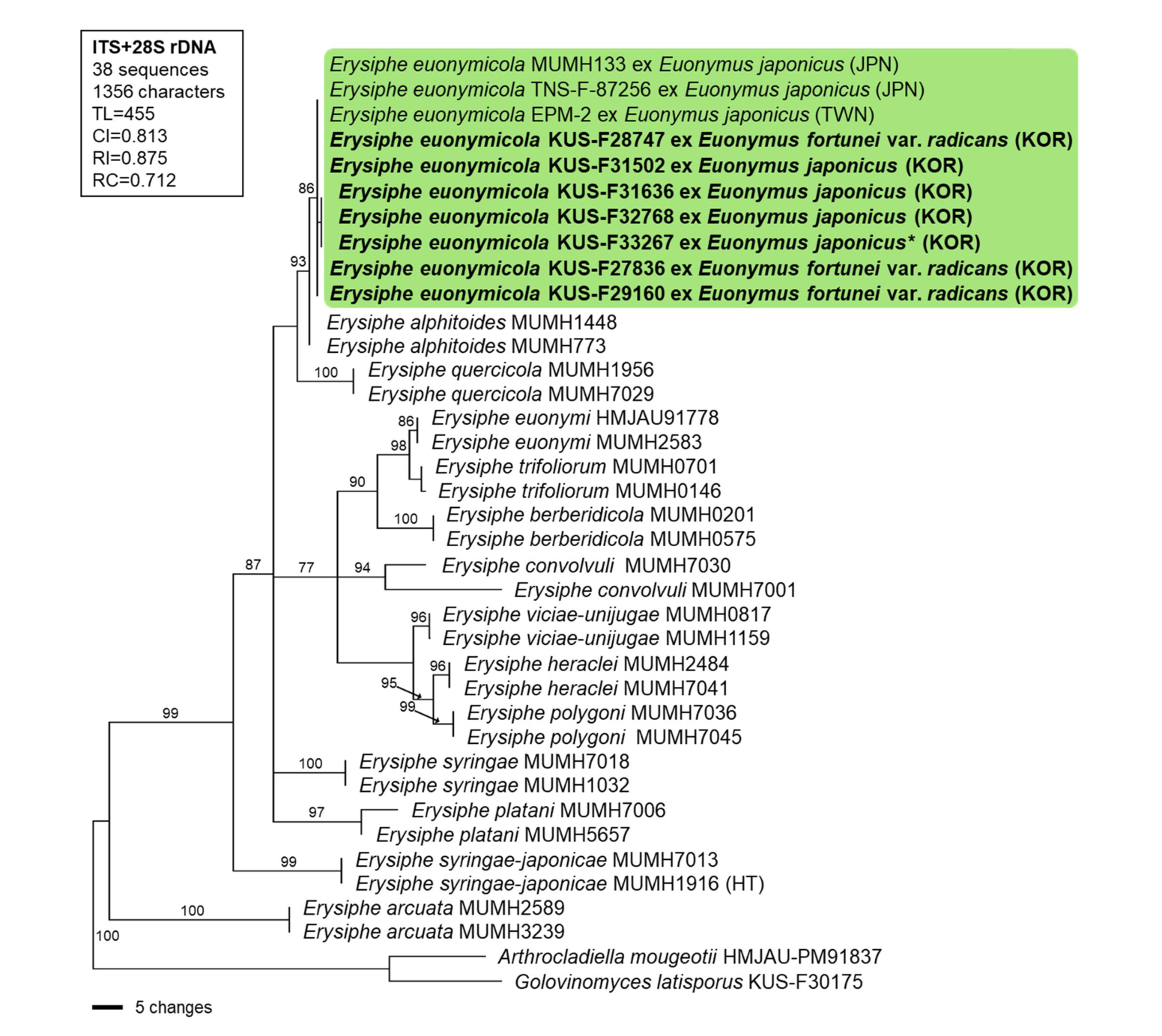
Fig. 2. Maximum parsimony phylogenetic tree inferred from combined ITS and LSU rDNA sequences showing the relationships of Korean powdery mildew specimens collected from Euonymus japonicus and Eu. fortunei var. radicans with related species in the Erysiphe alphitoides complex. Bootstrap values ≥ 70% obtained from 1,000 replications are indicated above the branches. Korean specimens examined in this study are shown in bold. Arthrocladiella mougeotii (HMJAU-PM91837) and Golovinomyces latisporus (KUS-F30175) were used as outgroup taxa. An asterisk (*) indicates the specimen collected from fruits of Eu. japonicus (KUS-F33267). ITS: internal transcribed spacer; 28S: 28S ribosomal DNA (large subunit, LSU); TL: tree length; CI: consistency index; RI: retention index; RC: rescaled consistency index; HT: holotype; JPN: Japan; TWN: Taiwan; KOR: Korea; MUMH: Mie University Mycological Herbarium; TNS-F: National Museum of Nature and Science, Tsukuba, Japan; HMJAU: Herbarium of Mycology, Jilin Agricultural University; KUS-F: Fungal specimens of Korea University Herbarium; EPM: Euonymus Powdery Mildew (Isolate name designated by the original researchers).
Powdery mildew fungi recorded on Euonymus species are currently classified into five species: E. euonymi, E. euonymicola, E. lianyungangensis, E. mayumi, and E. pseudopusilla [1]. Among these, E. euonymi and E. euonymicola are of particular interest because they are morphologically similar and have historically been confused. Erysiphe euonymi commonly produces chasmothecia and is widely distributed in Europe, western and central Asia, and parts of North America. In contrast, E. euonymicola is associated mainly with evergreen Euonymus species and has been reported from East Asia as well as other regions where its hosts are cultivated [1,2,4]. Despite examining specimens collected from evergreen Euonymus hosts at different times of year over multiple decades, no chasmothecia were observed in any specimen, but the anamorphic characteristics were generally consistent with previous descriptions of E. euonymicola [2,8]. Furthermore, all sequenced specimens formed a single clade with reference E. euonymicola sequences. These ecological, morphological, and phylogenetic characteristics support the identification of the Korean specimens as E. euonymicola.
Minor differences were noted between the anamorphic characteristics of the Korean specimens and those in the previous descriptions of E. euonymicola [2,8]. Previous studies described the foot-cells of conidiophores as straight to moderately flexuous-sinuous or usually straight [2,3,14,15]. In contrast, the Korean specimens examined here had foot-cells that were mostly flexuous and only occasionally straight. In addition, primary conidia were consistently distinguishable from secondary conidia in Korean specimens. Primary conidia were slightly shorter and characterized by rounded apices and subtruncate bases, whereas secondary conidia were cylindric-ellipsoidal to oblong-elliptical. Although primary conidia have previously been reported for E. euonymicola [8], detailed morphological observations and photographic documentation of these structures remain limited. Germ tube morphology also differed slightly from previous descriptions [2]. In a germination test of 105 conidia, all germ tubes originated from a subterminal position on the conidium, which corresponds with a report from Azerbaijan [15]. These observations provide additional morphological information for E. euonymicola, particularly regarding foot-cell morphology, primary conidia, and germination characteristics.
Powdery mildews on Eu. japonicus in Korea had previously been recorded as O. euonymi-japonici and E. euonymi-japonici, reflecting earlier nomenclatural treatments predating the recognition of E. euonymicola. A previous Korean record of E. alphitoides on Eu. japonicus requires confirmation because associations between E. alphitoides and Euonymus species have rarely been reported, and species delimitation within the E. alphitoides complex remains difficult [16,17]. In the present study, all specimens collected from Eu. japonicus, including a specimen obtained from infected fruit, and from Eu. fortunei var. radicans were identified as E. euonymicola. To our knowledge, fruit infection by E. euonymicola has not been previously reported for Eu. japonicus, so the specimen examined here provides evidence of a new infection type.
Among powdery mildew species known from the genus Euonymus worldwide, E. lianyungangensis, E. mayumi, E. pseudopusilla, and E. euonymi have not been found in Korea. Because Eu. americanus and Eu. europaeus, known hosts of E. pseudopusilla and E. euonymi, respectively, have been introduced into and are cultivated in Korea, continued monitoring is warranted to detect potential changes in the diversity of powdery mildew fungi infecting Euonymus. Given that Euonymus shrubs are increasingly recognized as important functional carbon sinks in urban ecosystems [18], tracking potential fungal outbreaks is crucial to preventing the degradation of their health and subsequent carbon uptake efficiency.
The authors declare that there are no conflicts of interest.
This work was financially supported by the Korea Forest Service Government (KFSG) as Graduate School Specialized in Carbon Sinks. This research was also supported by the Global-Learning & Academic research institution for Master’s·PhD students, and Postdocs (LAMP) Program of the National Research Foundation of Korea (NRF) grant funded by the Ministry of Education (No. RS-2024-00443714).
1. Farr DF, Rossman AY, Castlebury LA. United States National Fungal Databases [Internet]. Beltsville (MD): USDA ARS Mycology and Nematology Genetic Diversity and Biology Laboratory; 2026 [cited 2026 May 11]. Available from https://fungi.ars.usda.gov/
2. Braun U, Cook RTA. Taxonomic manual of the Erysiphales (powdery mildews). Utrecht: CBS-KNAW Fungal Biodiversity Centre; 2012.
3. Abbasi M, Braun U. Notes on powdery mildew of evergreen spindle Euonymus japonicus in Iran. J Crop Prot 2020;9:347-54. https://doi.org/10.48311/jcp.2020.1484
[DOI]
4. Braun U. The powdery mildews (Erysiphales) of Europe. Jena: Gustav Fischer Verlag; 1995.
5. Lee YH, Ryu JD, Kim BS, Lee EK, Chung BJ. Survey on the types, distribution, and damage of diseases of major crops. Suwon: Rural Development Administration; 1977. p. 5-18. (Research Report of the Strengthening Plant Protection Research and Training Project; 1976).
6. Kim JY, Lee JT. Survey on fungal diseases of ornamental plants (II). Agric Res Bull Kyungpook Natl Univ 1985;3:120-8.
7. Shin HD. Powdery mildew fungi and their host plants from Kangwon Province. Kor J Mycol 1994;22:229-46.
8. Lee CK, Lee SK, Lee SH, Cho SE, Shin HD. First report of powdery mildew caused by Erysiphe euonymicola on Euonymus fortunei var. radicans in Korea. Plant Dis 2015;99:556. https://doi.org/10.1094/PDIS-08-14-0848-PDN
[DOI]
9. Sivapalan A. Effects of water on germination of powdery mildew conidia. Mycol Res 1993;97:71-6. https://doi.org/10.1016/S0953-7562(09)81115-5
[DOI]
10. Choi IY, Abasova L, Choi JH, Choi BK, Shin HD. Erysiphe magnoliicola comprises the powdery mildew found on Magnolia kobus in Korea. Kor J Mycol 2022;50:125-30. https://doi.org/10.4489/KJM.20220012
[DOI]
11. Bradshaw M, Tobin PC. Sequencing herbarium specimens of a common detrimental plant disease (powdery mildew). Phytopathology 2020;110:1248-54. https://doi.org/10.1094/PHYTO-04-20-0139-PER
[DOI][PubMed]
12. Tamura K, Stecher G, Kumar S. MEGA11: Molecular evolutionary genetics analysis version 11. Mol Biol Evol 2021;38:3022-7. https://doi.org/10.1093/molbev/msab120
[DOI][PubMed]
13. Swofford DL. PAUP*. Phylogenetic analysis using parsimony (*and other methods). Version 4. Sunderland (MA): Sinauer Associates; 2002.
14. Chu HH, Chen XJ, Wang CL. First report of powdery mildew on Euonymus japonicus caused by Erysiphe euonymicola in Taiwan. Plant Dis 2023;107:4025. https://doi.org/10.1094/PDIS-06-23-1055-PDN
[DOI]
15. Abasova LV, Aghayeva DN, Takamatsu S. Notes on powdery mildews of the genus Erysiphe from Azerbaijan. Curr Res Environ Appl Mycol 2018;8:30-53. https://doi.org/10.5943/cream/8/1/3
[DOI]
16. Lee HB, Nguyen TTT. First report of powdery mildew caused by Erysiphe alphitoides on Euonymus japonicus in Korea. Plant Dis 2017;101:385. https://doi.org/10.1094/PDIS-08-16-1128-PDN
[DOI]
17. Bradshaw M, Braun U, Takamatsu S, Németh MZ, Seress D, Pfister DH. The Erysiphe alphitoides complex (powdery mildews) – unravelling the phylogeny and taxonomy of an intricate assemblage of species. N Z J Bot 2025;63:28-44. https://doi.org/10.1080/0028825X.2023.2276913
[DOI]
18. Jeong M, Bae J, Yoo G. Urban roadside greenery as a carbon sink: Systematic assessment considering understory shrubs and soil respiration. Sci Total Environ 2024;927:172286. https://doi.org/10.1016/j.scitotenv.2024.172286
[DOI][PubMed]